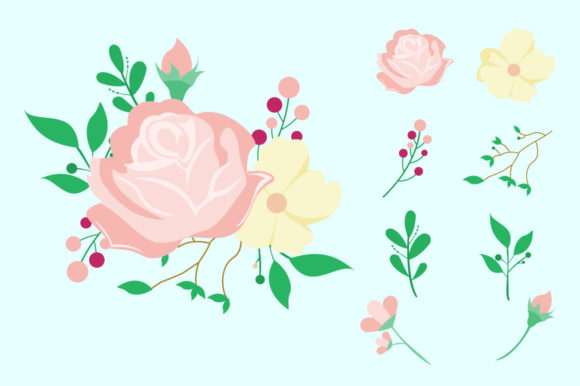
Unlocking Creative Potential with the 2D Flowers Bucket Digital Collection
In the rapidly evolving world of digital design, the demand for high-quality, versatile assets has never been higher. Whether you are a professional graphic designer managing tight deadlines for corporate clients or a hobbyist crafting personalized wedding invitations, the foundation of your project often rests on the quality of your raw materials. This is where a curated collection like the 2D Flowers Bucket becomes an indispensable resource. It represents more than just a folder of images; it is a comprehensive toolkit designed to streamline workflows, elevate aesthetic appeal, and provide the flexibility needed for modern creative endeavors.
The core value of this specific set lies in its technical precision and breadth of application. When designers search for floral elements, they often encounter low-resolution files that pixelate upon printing or rigid formats that refuse to integrate smoothly into complex layouts. The 2D Flowers Bucket addresses these pain points head-on by offering a suite of eight separate and distinct flower and plant objects, each rendered at a crisp 300 DPI. This resolution standard is the gold rule for print media, ensuring that whether you are producing a small business card or a large-format banner, the edges remain sharp and the colors vibrant.
Versatility Through Multiple File Formats
One of the most significant hurdles in digital asset management is compatibility. Different projects require different file types, and constantly converting images can lead to quality loss or wasted time. This collection eliminates that friction by providing files in EPS, AI, and JPG formats. Understanding why this trio is so powerful is key to maximizing the utility of the 2D Flowers Bucket.
- AI (Adobe Illustrator): For users within the Adobe ecosystem, having native AI files means the vectors are fully editable. You can change colors to match a specific brand palette, reshape petals to fit a unique composition, or isolate specific parts of the plant without losing any data.
- EPS (Encapsulated PostScript): This is the universal language of vector graphics. Even if you aren't using the latest version of Illustrator, EPS files ensure that your floral elements remain scalable to any size without degradation. This is crucial for large-scale applications like site banners or fabric printing.
- JPG (Joint Photographic Experts Group): Sometimes, speed is of the essence. For web graphics, social media posts, or quick mockups, the high-resolution JPGs included in the set allow for immediate drag-and-drop functionality without the need for complex software.
This multi-format approach ensures that the 2D Flowers Bucket fits seamlessly into diverse workflows, from the initial brainstorming phase to the final production output.
Elevating Print Projects: From Scrapbooking to Wedding Stationery
The tactile nature of print projects demands assets that look as good on paper as they do on a screen. The 300 DPI specification of this set makes it particularly suited for physical goods. Consider the realm of wedding stationery. Couples today often seek unique, DIY touches for their save-the-dates, invitations, and menu cards. By utilizing the distinct plant objects found in the 2D Flowers Bucket, creators can build bespoke borders, corner accents, or central motifs that feel organic and hand-crafted rather than generic.
Similarly, the scrapbooking community thrives on layering and texture. These eight separate objects allow for deep customization. A user can layer a leaf behind a flower, rotate them to create a natural flow, and adjust opacity to create depth. Because the files are high resolution, the final printed page in a memory book will retain its clarity years down the line. Furthermore, for those interested in fabric printing, the vector capabilities of the EPS and AI files mean designs can be scaled up to cover yards of textile for quilts, apparel, or home decor without the dreaded "pixelated" look that ruins professional finishes.
Optimizing Digital Presence and Branding
While print is a major use case, the digital landscape offers equally compelling opportunities for these assets. In an era where visual content drives engagement, web graphics and social media banners need to stand out. The clean lines and professional finish of the flowers in this set make them ideal for branding exercises.
Imagine a boutique florist or a wellness coach looking to establish a logo. The 2D Flowers Bucket provides the raw components to construct a unique mark. Since the objects are separate, a designer can combine a specific bloom with a particular leaf style to create a signature icon that isn't available in standard clip-art libraries. This level of uniqueness is vital for business cards and logos, where differentiation is the primary goal.
Moreover, for website headers or blog post illustrations, the JPG versions offer a lightweight yet high-quality solution. They load quickly, preserving site speed—a critical SEO factor—while adding a touch of elegance that stock photography often lacks. The ability to use these elements across planner stickers for digital planning apps also taps into the booming market of digital organization, where users customize their tablets with aesthetically pleasing functional items.
Practical Considerations for Modern Creators
When selecting digital assets, savvy creators look beyond just the image itself; they consider the efficiency of the workflow. The 2D Flowers Bucket is structured to respect the user's time. Having eight separate and different objects means you aren't forced to use a pre-composed scene that doesn't fit your layout. You have the autonomy to deconstruct and rebuild.
This modularity supports a wide range of industries. In the DIY projects sector, enthusiasts often work with limited tools. The inclusion of ready-to-use JPGs alongside professional vector files means that a user with basic software can still achieve professional results, while a power user can push the boundaries of design. It bridges the gap between amateur and professional capabilities.
Another practical benefit is the consistency of style. Often, designers waste hours trying to match flowers from different sources that have conflicting lighting, line weights, or artistic styles. This set guarantees a cohesive look. Whether you are designing a full suite of invitations or a series of cards for a holiday campaign, the visual language remains unified, reinforcing brand identity and aesthetic harmony.
Maximizing Value in Everyday Design
The true test of any digital asset is its frequency of use. A purchase that sits unused in a hard drive is a wasted investment. The diversity within the 2D Flowers Bucket ensures longevity. The eight distinct objects likely cover a variety of shapes and silhouettes, making them applicable for spring campaigns, summer sales, romantic themes, or even elegant corporate communications depending on how they are colored and arranged.
For educators and content creators, these elements can serve as decorative bullets in presentations, embellishments in e-books, or icons in instructional materials. The high resolution ensures that even when projected on a large screen or printed in a textbook, the details remain intact. The flexibility to switch between vector and raster formats means these files can travel with you from a quick mobile edit to a high-end desktop production suite.
In conclusion, integrating the 2D Flowers Bucket into your creative library is a strategic move for anyone involved in visual creation. It solves the common trifecta of design challenges: quality, compatibility, and versatility. By providing high-resolution 300 DPI files in industry-standard EPS, AI, and JPG formats, it empowers users to tackle everything from intricate fabric printing jobs to swift web graphic updates. The eight separate plant objects offer the freedom to customize, ensuring that every project, be it a planner sticker or a grand wedding stationery suite, feels unique and professionally executed. As the digital landscape continues to demand higher standards of visual communication, having a reliable, high-quality floral resource is not just a luxury—it is a necessity for efficient and beautiful design.