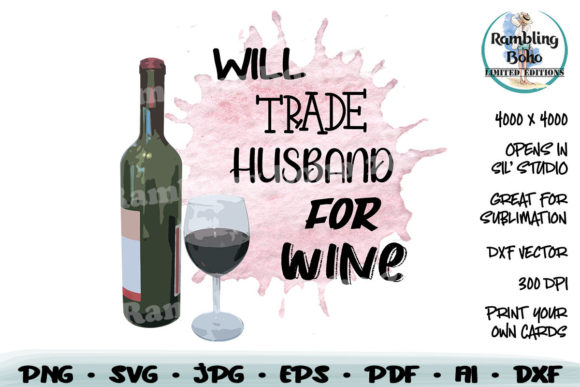
Integrating the Will Trade Husband for Wine Design into Professional Creative Workflows
In the fast-paced world of digital design and small business entrepreneurship, the difference between a successful product launch and a stalled project often lies in the quality and versatility of the assets used. The "Will Trade Husband for Wine" graphic is more than just a humorous phrase; it represents a high-quality digital asset designed to fit seamlessly into diverse production pipelines. Whether you are a freelancer managing client deadlines, a small business owner stocking an Etsy shop, or a hobbyist creating personalized gifts, understanding how to integrate this specific design file into your broader workflow is essential for maximizing efficiency and output quality.
This design serves as a prime example of a multi-format digital resource. It is not merely an image but a collection of vector and raster files engineered for compatibility across various software ecosystems. By treating this download as a foundational component of your creative process, you can streamline operations ranging from initial concept visualization to final physical production. The key to leveraging this asset effectively lies in recognizing its role at different stages of your project lifecycle: preparation, execution, and quality control.
Asset Preparation and File Compatibility
The first stage of any successful design project is ensuring that your tools and assets are compatible. The "Will Trade Husband for Wine" package addresses this by providing a comprehensive suite of file formats, including SVG, DXF, PNG, JPG, EPS, PDF, and AI. This variety eliminates the common bottleneck of file conversion, allowing creators to move immediately into the design phase.
For users working with cutting machines like Silhouette Cameo or Cricut, the included SVG format is critical. Unlike standard images, SVGs retain their vector properties, meaning they can be scaled infinitely without losing resolution. When importing this file into Silhouette Studio, the clean lines and rich colors allow for precise path detection. This reduces the time spent manually tracing images or cleaning up jagged edges, a frequent pain point in vinyl cutting workflows. Similarly, the DXF file offers a non-color vector path specifically optimized for laser cutters and CAD software. If your workflow involves industrial engraving or precise architectural plotting, the DXF ensures that the machine reads the geometry correctly, regardless of the software's color handling capabilities.
Preparation also involves organizing these assets within your digital library. Because the graphic is provided at 4000px x 4000px with a resolution of 300dpi, it is ready for high-fidelity print work immediately upon download. There is no need to upscale or enhance the image, which often introduces artifacts. By storing these files in a structured folder system categorized by format, you ensure that whether a client requests a web-ready PNG or a print-ready PDF, the correct asset is instantly accessible.
Implementation Across Production Methods
Once the assets are prepared, the "Will Trade Husband for Wine" design can be deployed across multiple production channels. Its versatility allows it to function effectively in both digital and physical contexts, making it a valuable resource for entrepreneurs who need to diversify their product offerings without sourcing new designs for each medium.
In the realm of sublimation, the high-resolution PNG and JPG files are indispensable. Sublimation requires images with vibrant colors and sharp details to transfer effectively onto substrates like mugs, tumblers, and towels. The rich colors mentioned in the design specifications ensure that the final product matches the on-screen preview, minimizing waste due to color banding or pixelation. When applying this to a tumbler, for instance, the 13-inch approximate size of the graphic allows for full-wrap coverage or large central placement, giving the creator flexibility in layout decisions.
For heat transfer and iron-on applications, the workflow shifts slightly. Here, the SVG or EPS formats are preferred because they allow the user to separate design elements if necessary. Although the EPS and AI files are flattened to preserve the integrity of the design elements, they remain editable within vector software like Adobe Illustrator. This means you can adjust the size to fit specific garment dimensions or combine the text with other graphical elements to create a unique composite design. The ability to alter the size in various programs ensures that the design fits perfectly on everything from a small pocket logo to a large back-print on a t-shirt.
Furthermore, the inclusion of a PDF format bridges the gap between digital design and traditional printing. For educators or publishers looking to include this graphic in printed materials, cards, or promotional flyers, the PDF ensures that fonts and layouts remain consistent across different devices and printers. This consistency is vital for maintaining brand identity and professional standards in printed collateral.
Workflow Integration and Decision Making
Integrating this design into a business workflow also influences decision-making processes regarding inventory and product testing. Because this is a digital download with no physical products sent, it allows for a low-risk approach to market testing. Entrepreneurs can produce small batches of items—such as a limited run of wine-themed stickers or waterslides—to gauge customer interest before committing to larger production runs.
The "Decisions, decisions" aspect of the creative process is simplified by the asset's adaptability. You do not need to decide between a vector or raster workflow; the package supports both. If you are working on a tight deadline for a client who needs a sticker sheet, you might utilize the DXF for rapid cutting. Conversely, if the same client later requests a digital social media graphic, you can switch to the transparent PNG file without needing to recreate the artwork. This fluidity between formats supports an agile workflow where pivot points are handled smoothly rather than becoming roadblocks.
Moreover, the design interacts well with other resources. For marketers, this graphic can be part of a larger campaign targeting wine enthusiasts or those with a sense of humor about relationships. It can be combined with copywriting assets, social media templates, and email marketing sequences. The neutral yet bold style of the design allows it to sit comfortably alongside various branding elements without clashing, provided the color palette is managed correctly.
Quality Control and Long-Term Usability
Maintaining high standards in output requires rigorous quality control, and the technical specifications of this design facilitate that process. The 300dpi resolution is the industry standard for professional printing, ensuring that text remains crisp and lines stay sharp even upon close inspection. However, creators must remain aware that colors may vary slightly due to screen settings and printing methods. A practical tip for mitigating this is to perform a test print on the specific material intended for the final product. Whether using sublimation ink on polyester or vinyl on cotton, a single prototype can reveal necessary adjustments in brightness or contrast before full-scale production begins.
Long-term usability is another factor where this asset excels. Digital trends change rapidly, but classic, humor-driven phrases tend to have staying power. By archiving the original source files (AI and EPS), you preserve the ability to revisit and modify the design years down the line. Perhaps in the future, you will want to update the font style or change the color scheme to match a seasonal trend. Having the flattened yet editable AI file ensures that the core geometry of the design remains intact while allowing for surface-level customization.
Organization plays a crucial role in long-term efficiency. Tagging these files with relevant metadata such as "wine," "humor," "vector," and "sublimation" in your digital asset management system will make them easily retrievable for future projects. This habit prevents the common issue of "lost files" and ensures that your library remains a productive resource rather than a digital graveyard.
Practical Tips for Seamless Execution
To get the most out of the "Will Trade Husband for Wine" design, consider the following implementation strategies:
- Verify Machine Settings: Before cutting the DXF or SVG, always run a test cut on a scrap piece of material. Different vinyl brands and thicknesses require different pressure and speed settings.
- Check Transparency: When using the PNG files for web or overlay purposes, open the file in your editor to confirm the background is truly transparent, especially if you plan to place it over colored backgrounds.
- Scale Proportionally: While the size can be altered, maintain the aspect ratio to prevent distortion of the text and graphical elements. The 13x13 inch base size provides a generous canvas for scaling down, but scaling up beyond the original vector limits (if any raster effects were applied) should be done with caution.
- Layer Management: If combining this design with other elements in software like Illustrator or Silhouette Studio, use layers to keep the "Will Trade Husband for Wine" graphic separate. This makes it easier to toggle visibility or export specific parts of the composition later.
Ultimately, the value of this digital design lies in its ability to adapt to your specific needs. It is a tool that supports creativity rather than constraining it. By understanding the strengths of each file format and planning your production steps accordingly, you can integrate this asset into your workflow with confidence. Whether you are producing a single custom mug for a friend or manufacturing hundreds of t-shirts for a retail store, the "Will Trade Husband for Wine" graphic provides the reliability and quality necessary to execute your vision effectively.